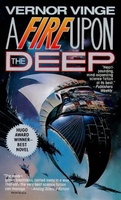
This review is a little different from most. Here I’ll just be talking about the enhancements to the *echo* Special Edition *echo*, as opposed to the actual book content, but they are fascinating all by themselves, too.
I was checking out Tor.com today, and I found Patrick Nielsen Hayden mentioning an article about Vernor Vinge’s Rainbow’s End in the New York Times. Vinge’s name had also came up with praise in Jo Walton’s post, A Deepness in the Sky, the Tragical History of Pham Nuwen. Thus reminded, I decided to fulfill my desires for instant gratification and checked out the Kindle Store.
A Deepness in the Sky is actually a prequel to A Fire Upon the Deep, but I never let that sort of thing bother me. And it shouldn’t bother you, either, since it was published after A Fire Upon the Deep (just as A Fire Upon the Deep was published after a novella for which it was a prequel itself). Both Deepness and Fire are available in the Kindle store, but I noticed a very interesting thing.
There were two versions of A Fire Upon the Deep in the Kindle Store. One was a “Special Edition” from St. Martin’s Press, while the other was a “regular” edition from Tor. And it wasn’t just a “Special Edition” with extra introductions and retrospectives, but a “Special Edition eBook“.
This intrigued me, so I bought them both. I know. I take this upon myself so you don’t have to.
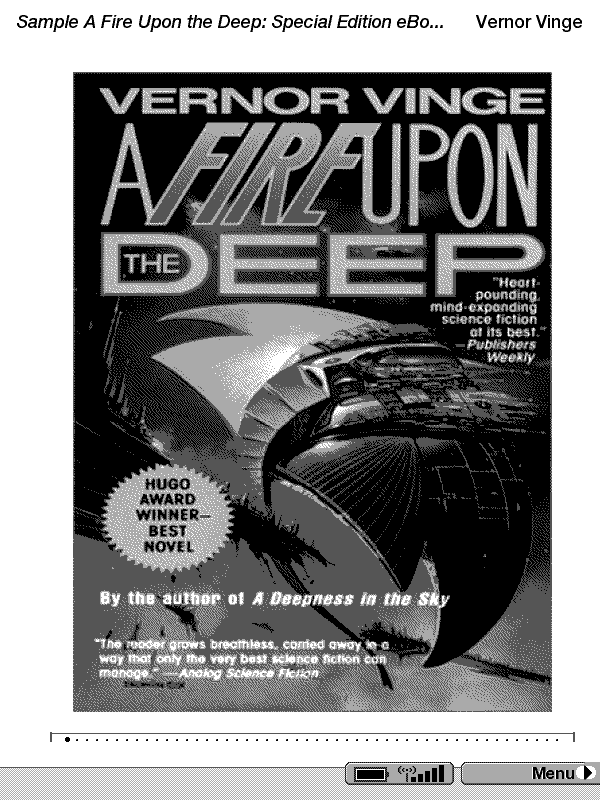
So what makes a Special Edition eBook so special in this case? Especially since you’re paying, as of this writing, $1.60 more.
It turns out that whoever assembled the special edition of A Fire Upon the Deep is an eBook maker after my own heart. I’ve discussed the interesting aspects of putting the Shadow Unit Season One eBook together here and here, as it’s a hyper-linked work.
Turns out that Vernor Vinge did similar things, except with grep, plain text files, and comments embedded within his draft that started with ^ and had special tags. These comments and annotations expanded over time and developed as the work progressed, even ending up as conversations between Vinge and his consultants.
(Which brings up one question in mind: what did he mean by consultants? Editors? His agent? Writing friends who were thick as thieves with him? No idea, but it’s something special to have a recorded, ongoing dialogue as a writer shapes his or her work.)
As a result, when you go about making a special edition of one of Vernor Vinge’s Hugo Award winning works, you have a lot of material to work with. Maybe a bit too much. If we were talking about a paper book, there’d be so many footnotes scattered about that either they’d need to stack at the end of chapters or, heavens forbid, the end of the book in one big mess. The alternative is to stack the notes up at the bottom of the text, which is disturbing in its own way, though this method preserves locality of reference to a single page.
And that’s what people usually do in these super-annotated works. I’ve seen a footnote in the Annotated Sherlock Holmes stretch across four pages. In the middle of a story. It’s quite informative and usually illustrated, but assumes you’ve already read the stories in question, so you would not mind being disturbed for a fireside chat about Old White Men Holmes/Moriarty Slash. ((And that’s a post for Holmesian Derivations some day, let me tell you.)) And it’s not just once that you get disturbed, even if you have columns on the left and right to preserve, as much as possible, the flow of the main text. Special annotated editions are not for first-timers.
Ah, but a Special Edition eBook can make use of the hyper-linking idiom. You can jump back and forth between a note and the work, or simply continue reading the work undisturbed if you’re a first-timer. And even a first-timer could even look at the notes without being lifted too much out of place. And being able to jump from note to note easily also solves the otherwise navigation-troubling note-that-refers-to-the-sixth-note-of-chapter-xvii.
Enough of that, though. Time for some real screenshots to illustrate what I mean, under the cut.
 Spontaneous ∂erivation